
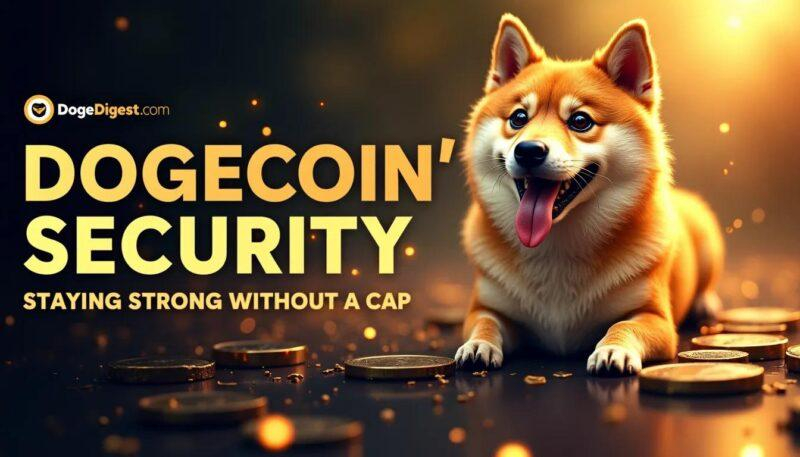
In the ever-evolving universe of cryptocurrencies, Dogecoin has carved out a unique niche-not just as a meme-inspired token, but as a resilient digital asset with a distinctive approach to its monetary policy. Unlike many of its peers, Dogecoin operates without a maximum supply cap, a feature that sparks both curiosity and debate about its long-term security and value stability. This article delves into the mechanics behind Dogecoin’s security model, exploring how it maintains network strength and trust in an uncapped supply landscape-revealing a story of innovation and community commitment that keeps this playful currency standing strong.
Understanding Dogecoin’s Security Framework and Blockchain Integrity
Dogecoin’s security architecture thrives on principles that have proven resilient over years of real-world use. Unlike some cryptocurrencies with fixed supply caps, Dogecoin relies on continuous production of new coins, which might seem risky at first glance. However, this endless supply actually underpins its robust security model by sustaining active mining participation and network decentralization. By encouraging a steady flow of miners, Dogecoin maintains strong consensus and diminishes the chances of 51% attacks, keeping its blockchain reliably secure.
The blockchain’s integrity is maintained through a meticulously designed consensus mechanism paired with network incentives that promote honest behavior. Below is a brief overview of key elements that secure the Dogecoin infrastructure:
- Scrypt Algorithm: This ASIC-resistant proof-of-work algorithm ensures a wide range of miners can participate, enhancing decentralization.
- Merged Mining: Dogecoin’s ability to merge-mine with Litecoin allows miners to work simultaneously on both networks, increasing security without added energy consumption.
- Inflationary Supply: A constant block reward motivates ongoing mining, avoiding stagnation and reinforcing network vigor.
Understanding these components can be simplified by examining how Dogecoin’s supply policy contrasts with capped cryptocurrencies within the framework of network security:
| Feature | Dogecoin | Capped Cryptocurrencies |
|---|---|---|
| Supply Model | Inflationary, unlimited coins | Fixed, limited coins |
| Network Security | Sustained via constant mining incentives | Potential mining drop post cap |
| Mining Participation | High due to accessible algorithm | May decline after supply limit reached |
Examining the Impact of Unlimited Supply on Network Stability
Unlike cryptocurrencies with a fixed maximum supply, Dogecoin operates on a model of continuous issuance, which some might immediately associate with inflationary risks. However, this unlimited supply does not inherently translate to a weakening of the network’s security. In fact, the consistent block rewards motivate miners to remain active, maintaining a robust hash rate that protects Dogecoin from potential 51% attacks. By encouraging steady participation, Dogecoin ensures that the blockchain remains decentralized and resilient over time.
Key aspects supporting network stability despite unlimited supply include:
- Steady Mining Incentives: With fixed block rewards, miners have ongoing reasons to secure the network rather than turning their equipment to other coins.
- Inflation-Control Mechanisms: The annual issuance rate is controlled and predictable, warding off runaway inflation while still offering proportional rewards.
- Community and Developer Support: A passionate, dedicated community ensures continuous upgrades and maintenance, reinforcing network integrity.
| Metric | Dogecoin (Unlimited Supply) | Bitcoin (Fixed Supply) |
|---|---|---|
| Annual Block Reward | 5,000 DOGE (constant) | Varies, halves every 4 years |
| Total Supply | Inflationary (increases yearly) | 21 Million BTC |
| Hash Rate Stability | Consistently high | Variable but strong |
| Security Model | Steady incentives | Scarcity-driven value |
Key Challenges in Protecting Dogecoin from Vulnerabilities
The decentralized nature of Dogecoin presents unique hurdles in safeguarding its blockchain. Unlike capped cryptocurrencies, Dogecoin’s unlimited supply model fuels ongoing mining activity, which, while vital for network security, can also attract malicious actors aiming to exploit hash power fluctuations. Maintaining consensus integrity becomes increasingly difficult as miners weigh the profitability of Dogecoin against other cryptocurrencies, creating potential windows of vulnerability during market volatility.
Another major concern lies in the network’s reliance on auxiliary security mechanisms rather than robust native safeguards. Since Dogecoin shares its codebase roots with Litecoin, it inherits both strengths and weaknesses, but lacks the continuous protocol upgrades seen in larger chains. This can result in slower responses to emerging threats such as 51% attacks or double-spending attempts. Community-driven patching efforts, while valuable, often face coordination challenges, leading to delayed implementation of critical security updates.
To visualize the ongoing security trade-offs, consider the following table outlining some common vulnerabilities alongside Dogecoin’s current mitigation strategies:
| Vulnerability | Risk Level | Mitigation Approach |
|---|---|---|
| 51% Attack | Medium | Mining decentralization & community alerts |
| Double Spending | Low | Confirmation depth & network monitoring |
| Protocol Stasis | High | Periodic soft forks & community proposals |
- Continuous mining incentives ensure long-term network participation but can cause supply inflation challenges.
- Community vigilance acts as a grassroots defense mechanism but may suffer from uneven responsiveness.
- Protocol adaptability remains crucial to counter novel threats but requires strong developer engagement.
Strategies for Enhancing Security in a Capless Cryptocurrency
Maintaining robust security in a cryptocurrency without a fixed supply cap requires innovative mechanisms that adapt to the unlimited issuance model. One approach is the implementation of dynamic fee structures, where transaction fees fluctuate based on network activity. This not only discourages spam but also incentivizes miners to prioritize legitimate transactions, bolstering network integrity despite inflationary pressures.
Another essential strategy involves enhanced distributed consensus algorithms designed to resist centralization risks. By encouraging decentralization through increased node accessibility and lightweight validation protocols, the network minimizes vulnerabilities from concentrated mining power. Additionally, continuous upgrades to cryptographic protocols ensure resilience against evolving threats, maintaining trust in an open, uncapped ecosystem.
Balancing these strategies with community engagement creates a robust security framework. Educating users on best practices and fostering transparent governance can reduce attack vectors like social engineering or software exploits. Below is a simplified overview of key measures applied to safeguard Dogecoin’s network:
| Security Measure | Description | Benefit |
|---|---|---|
| Dynamic Fees | Adjust fees based on transaction volume | Reduces spam and prioritizes real transactions |
| Decentralized Nodes | Encourages diverse network participation | Prevents centralization of mining power |
| Protocol Upgrades | Regular updates to cryptographic algorithms | Protects against emerging cyber threats |
| User Education | Community-driven security awareness | Mitigates social engineering and exploits |
Best Practices for Users to Safeguard Their Dogecoin Holdings
In the ever-evolving landscape of Dogecoin, keeping your digital assets secure is paramount. Users should start by opting for hardware wallets or reputable cold storage solutions rather than relying on hot wallets that are connected to the internet. This not only adds a layer of physical security but also significantly reduces exposure to hacking attempts. When using software wallets, enabling two-factor authentication (2FA) and regularly updating wallet applications can serve as crucial shields against unauthorized access.
Awareness and vigilance play a vital role. Regularly verifying transaction details, such as wallet addresses before sending Dogecoin, can prevent costly mistakes or falling victim to scams. Be cautious with public Wi-Fi networks, especially when managing your Dogecoin holdings remotely; secure your internet connections with VPNs to keep sensitive information safe from prying eyes. Additionally, separating wallets for daily trading and long-term storage can minimize risks associated with frequent transactions.
Consider this quick security checklist designed for Dogecoin holders:
- Use multisignature wallets for added transaction approvals
- Backup seed phrases offline in multiple secure locations
- Monitor wallet activity regularly for any suspicious behavior
- Stay informed about Dogecoin updates and potential vulnerabilities
| Security Measure | Benefit |
|---|---|
| Hardware Wallet | Offline protection, immune to malware |
| Two-Factor Authentication | Prevents unauthorized logins |
| Multisignature Wallets | Requires multiple approvals for transactions |
| VPN Usage | Encrypts internet traffic, securing access |
Q&A
Q&A: Dogecoin’s Security – Staying Strong Without a Cap
Q1: What does it mean that Dogecoin “has no cap”?
A1: Unlike Bitcoin’s hard limit of 21 million coins, Dogecoin has no maximum supply. This means new Dogecoins can continue to be minted indefinitely, creating an inflationary model rather than a deflationary one.
Q2: Does having no cap make Dogecoin less secure?
A2: Not necessarily. Security in cryptocurrencies often hinges on network participation and consensus mechanisms rather than just coin supply. Dogecoin uses a Proof-of-Work (PoW) system, relying on miners to validate transactions and secure the network, much like Bitcoin.
Q3: How does Dogecoin maintain strong network security without a capped supply?
A3: The continuous block rewards incentivize miners to keep the network running. Dogecoin’s relatively low transaction fees and fast block times encourage more users and miners to participate, supporting the chain’s integrity over time.
Q4: Could infinite supply lead to devaluation that compromises security?
A4: Inflation can impact the coin’s market value, but security depends on miners’ incentives. As long as mining remains profitable and the network has sufficient hashing power, Dogecoin stays robust. Additionally, merged mining with Litecoin allows miners to secure both coins simultaneously, enhancing Dogecoin’s security.
Q5: What role does merged mining play in Dogecoin’s security?
A5: Merged mining lets Litecoin miners also mine Dogecoin without extra effort. This shared mining power boosts Dogecoin’s network hashrate, making it harder for bad actors to execute attacks like 51% takeovers, thereby strengthening security.
Q6: Are there any risks unique to Dogecoin’s uncapped supply model?
A6: An uncapped supply can lead to long-term inflation, potentially impacting investor perception and market dynamics. However, from a purely technical security standpoint, the ongoing rewards keep miners engaged and the network resilient.
Q7: How does Dogecoin’s security compare to capped cryptocurrencies?
A7: While capped currencies might create scarcity that could theoretically increase value and miner incentives, Dogecoin relies on steady issuance and community engagement. Its fast transactions and merged mining partnerships create a unique security ecosystem that remains effective even without a cap.
Q8: Can Dogecoin’s security evolve further in the future?
A8: Absolutely. The Dogecoin community and developers continuously explore upgrades and collaborations that could enhance scalability, efficiency, and security, ensuring the coin adapts to a dynamic crypto landscape.
In summary, Dogecoin’s uncapped supply is an unusual feature in the crypto world, but its security thrives on strong mining incentives, merged mining with Litecoin, and active community participation – proving that a cap isn’t the only path to a resilient network.
Insights and Conclusions
As Dogecoin continues to ripple through the currents of the crypto ocean, its security remains a steadfast lighthouse-guiding users safely despite the absence of a fixed cap. While some may see unlimited supply as a vulnerability, Dogecoin’s community-driven resilience and robust network defenses prove that strength isn’t solely measured in scarcity. In a landscape often defined by volatility and uncertainty, Dogecoin’s enduring security offers a curious blend of simplicity and reliability, reminding us that sometimes, staying strong is about more than just the numbers.
